
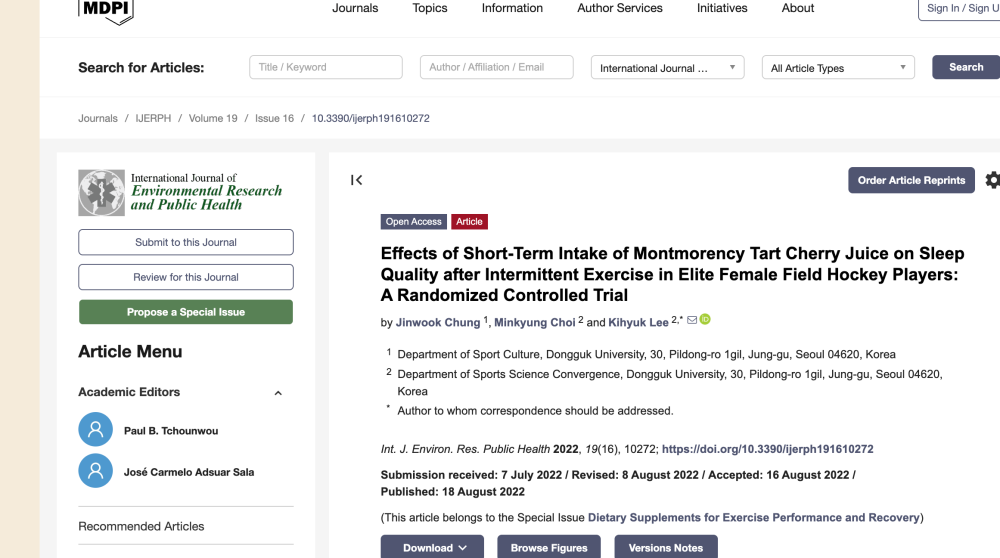
Abstract
- Background
High-intensity intermittent exhaustive exercise performed by elite female athletes often induces severe physiological stress, autonomic nervous system overactivation, elevated circulating cortisol levels, and subsequent disruptions in circadian regulation and sleep quality. Sleep recovery is essential for athletic restoration and sustained performance. Montmorency tart cherry juice (Prunus cerasus L.) is a natural botanical source rich in exogenous phytochemicals, anthocyanins, and bioavailable melatonin, which have been proposed to support circadian rhythms, modulate stress hormone profiles, and enhance restorative sleep architecture. While various studies explored sleep outcomes, empirical clinical data investigating the specific hormonal (cortisol and melatonin) and objective sleep responses following short-term tart cherry supplementation specifically in elite female athletes after exhaustive intermittent exercise remained necessary. This randomized controlled trial was designed to investigate the effects of short-term tart cherry juice consumption on plasma cortisol, melatonin concentrations, and actigraphy-derived sleep parameters in elite female field hockey players.
- Methods
A rigorous, randomized, double-blind, placebo-controlled parallel clinical trial was conducted involving a total of 19 elite female field hockey players participating over a 5-day study protocol. Subjects were randomly assigned to either a placebo control group (PLA, $n = 9$) or a tart cherry juice supplementation group (TCJ, $n = 10$). Participants completed a standardized protocol of intermittent exhaustion exercise. Following the exhaustive exercise bout, participants consumed either tart cherry juice or an organoleptically matched placebo drink five times over a total 48-hour double-blinded supplementation window. Actigraphy devices were distributed and continuously worn by participants during all sleep periods throughout the study duration to objectively analyze sleep quality and architecture. Blood samples were collected to quantify circulating levels of melatonin and cortisol. Evaluated endpoints included plasma melatonin concentrations, serum cortisol levels, total time in bed (TTB), wake after sleep onset (WASO), and the movement index (MI).
- Results
Analysis of the physiological and actigraphy metrics revealed distinct outcomes regarding hormonal responses and sleep quality:
Hormonal Responses (Melatonin & Cortisol): Statistical analysis revealed no significant interaction effect (group $\times$ time) between the PLA and TCJ groups regarding circulating levels of melatonin and cortisol, indicating that short-term supplementation did not significantly alter these specific systemic stress and circadian hormone concentrations under the tested protocol.
Sleep Quality Improvements: Conversely, objective sleep variables demonstrated statistically significant interaction effects favoring the tart cherry group, specifically with regards to total time in bed (TTB; $P = 0.015$), wake after sleep onset (WASO; $P = 0.044$), and the movement index (MI; $P = 0.031$), reflecting enhanced sleep efficiency and reduced restless waking.
The supplementation protocol was well-tolerated with high compliance.
- Conclusions
Short-term intake of tart cherry juice does not significantly alter circulating levels of melatonin or cortisol in elite female field hockey players following intermittent exhaustion exercise, but it effectively improves objective sleep quality parameters, including reductions in waking after sleep onset and movement index. These clinical findings suggest that tart cherry juice can serve as a beneficial nutritional aid to support sleep architecture and recovery in elite female athletes independently of major acute changes in systemic melatonin or cortisol concentrations.
https://www.mdpi.com/1660-4601/19/16/10272