
Abstract
- Background
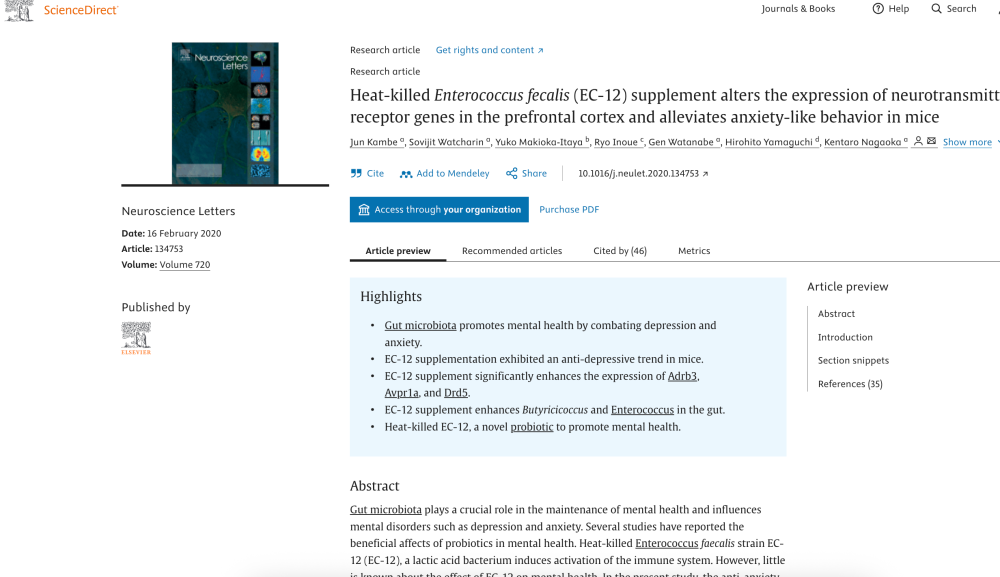
Gut microbiota plays a crucial role in the maintenance of mental health and influences mental disorders such as depression and anxiety. Several studies have reported the beneficial effects of probiotics in mental health. Heat-killed Enterococcus faecalis strain EC-12, a lactic acid bacterium, induces activation of the immune system; however, little is known about the effect of EC-12 on mental health. In the present study, the anti-anxiety effect of EC-12 was elucidated in vivo.
- Methods
Male mice were fed a diet supplemented with heat-killed Enterococcus faecalis strain EC-12. Behavioral assays, including the open-field test, elevated plus-maze test, and forced swim test, were conducted to evaluate anxiety-like and depressive-like behaviors. The expression of neurotransmitter receptor genes (Adrb3 and Avpr1a) in the brain was quantified, and gut microbiota composition was analyzed using next-generation sequencing. Additionally, the effects of sodium butyrate administration were compared against control groups.
- Results
Male mice fed the EC-12 supplemented diet showed decreased anxiety-like behavior in the open-field and elevated plus-maze tests, alongside an anti-depressive trend in the forced swim test. The expression of neurotransmitter receptor genes Adrb3 and Avpr1a was significantly enhanced in EC-12 supplemented mice compared to control mice. Furthermore, next-generation sequencing revealed a significant increase in the relative abundance of Butyricicoccus and Enterococcus following EC-12 supplementation, whereas sodium butyrate administration showed no significant differences in prefrontal cortex neurotransmitter receptor gene expression compared to controls.
- Conclusions
This study is the first to report the anti-anxiety potential of heat-killed Enterococcus faecalis strain EC-12 as a novel probiotic to promote mental health. While EC-12 successfully reduces anxiety-like behavior, enhances specific neurotransmitter receptor gene expression, and alters gut microbiota composition, further research is needed to fully elucidate the exact underlying mechanisms.
https://www.sciencedirect.com/science/article/abs/pii/S0304394020300239